Planning Guide
Altitude Sickness in Nepal
Altitude sickness starts above 2,500 m and almost every case is preventable. What matters is knowing which symptoms mean stop and rest, and which mean go down tonight. I have turned groups around within 200 m of a summit over exactly this.
The short version
- 1.Altitude sickness begins above 2,500 m. On an Annapurna Base Camp or Everest trek you will cross that on day two or three.
- 2.Above 3,000 m, gain no more than 300 to 500 m of sleeping altitude a day, and take a rest day every 1,000 m. That single rule prevents most cases.
- 3.AMS means stop and rest. Headache plus nausea or poor sleep, but breathing normally and walking straight.
- 4.HAPE and HACE mean descend tonight. The dividing line is breathlessness sitting still, or being unable to walk heel to toe.
- 5.Never ascend with symptoms, and never leave someone with symptoms alone. Descent is the only treatment that always works.
.webp&w=3840&q=75&dpl=dpl_HdCFUfNsbPqT3QfXix3vzda5r5CE)
What Is Acute Mountain Sickness (AMS)?
At sea level, each breath delivers roughly 21% oxygen at normal atmospheric pressure. At 5,000 m (Everest Base Camp), that pressure drops by almost half - your body receives significantly less oxygen per breath even though the percentage remains the same. AMS is your body's inflammatory response to this hypoxic stress when the ascent has been too fast for physiological adaptation.
AMS is not correlated with age, gender, or fitness level. Elite athletes get it; sedentary first-time trekkers sometimes do not. Your only protection is pace.
AMS Symptoms to Watch For
AMS typically appears 6–12 hours after arriving at a new altitude. If you wake with a persistent headache after an acclimatization night, do not ascend further that day.
Headache
Primary indicator - do not ignore
Nausea / vomiting
Moderate concern
Fatigue and weakness
Common, monitor progression
Dizziness / lightheadedness
Moderate concern
Loss of appetite
Common at altitude
Difficulty sleeping
Normal above 3,500 m
Shortness of breath at rest
Urgent - may indicate HAPE
Confusion / disorientation
Emergency - descend now
How fast is too fast? Safe ascent rates by altitude
The limit is sleeping altitude, not the highest point you touch during the day. Climbing high and sleeping low is good practice. Climbing high and sleeping high is how people get into trouble.
| Altitude band | Max sleeping gain per day | Rest days | Where this bites on Annapurna |
|---|---|---|---|
| Below 2,500 m | No limit in practice | Not needed | Pokhara to Ghorepani |
| 2,500 to 3,000 m | 500 m | Not usually needed | Ghorepani to Tadapani |
| 3,000 to 4,500 m | 300 to 500 m | One every 1,000 m | Chhomrong to ABC, Manang to Thorong Phedi |
| Above 4,500 m | 300 m | One every 600 to 900 m | Thorong Phedi to Thorong La |
The standard itineraries I run are built around these numbers. Where a teahouse gap forces a bigger gain, we take the rest day on the far side rather than push two big days together.
Prevention: The Rules That Actually Work
✓Ascend no more than 300–500 m per day above 3,000 m
This is the single most effective prevention measure. On Annapurna Base Camp (4,130 m) and EBC (5,364 m) routes, this rule is built into well-structured itineraries.
✓Take a rest day every 1,000 m of elevation gain
Acclimatization days - where you hike high and sleep low - are not optional padding. They are the mechanism by which your body increases red blood cell production.
✓Drink 3–4 litres of water daily
Dehydration worsens every AMS symptom and can mimic its early signs. High altitude, cold air, and physical exertion dramatically increase fluid loss.
✓Avoid alcohol and sleeping pills above 3,000 m
Both suppress respiratory drive - the automatic increase in breathing rate your body uses to compensate for altitude. Alcohol also causes dehydration.
✓Do not ascend with AMS symptoms
Never push through a headache. If symptoms are present in the morning, rest for 24 hours at the same altitude. Ascend only if symptoms fully resolve.
Diamox (Acetazolamide) - What You Need to Know
Acetazolamide (brand name Diamox) is a carbonic anhydrase inhibitor that stimulates faster, deeper breathing - accelerating the body's acclimatization process. It is the only medication with strong clinical evidence for preventing and treating AMS.
Standard preventive dosage
125 mg twice daily (morning and evening), starting 24 hours before ascending above 2,500 m. Continue for 48 hours after reaching maximum altitude. Lower dose reduces side effects (tingling in hands and feet, increased urination) while maintaining efficacy.
Diamox does not mask symptoms - it accelerates acclimatization. You must still follow all ascent rate rules. Diamox is not a substitute for proper pacing.
AMS vs HAPE vs HACE: know the difference
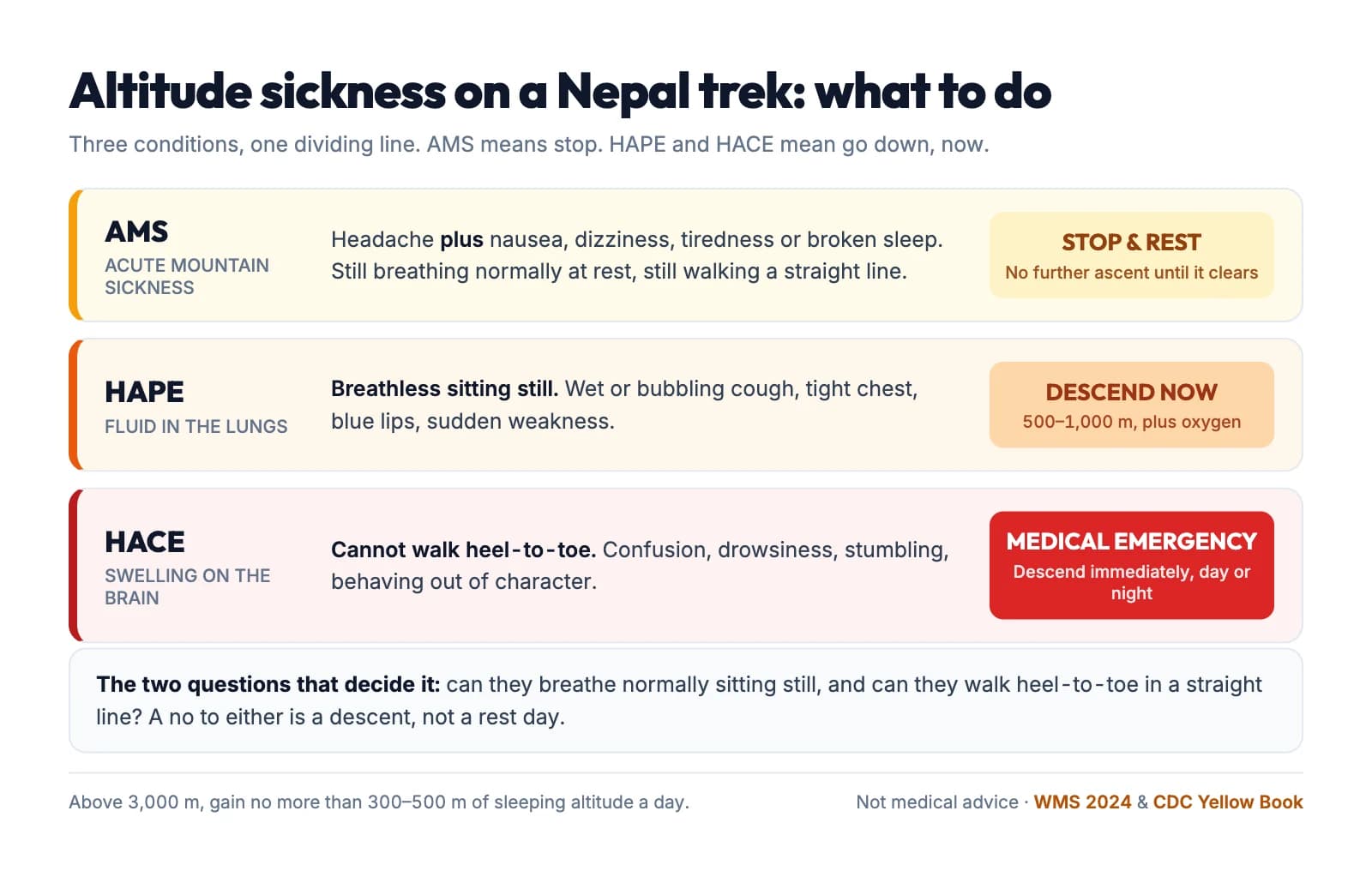
AMS exists on a spectrum. At the severe end, it can progress to two life-threatening conditions: HAPE and HACE. Both require immediate descent, not descent tomorrow morning, not after one more rest day. Immediate.
Acute Mountain Sickness - Mild to Moderate
Headache, nausea, fatigue, dizziness. Does not progress to HAPE or HACE in most cases if managed correctly. Reversible with rest at the same altitude or descent. Do not ascend while symptomatic.
Action: Rest, hydrate, take Diamox if prescribed, monitor closely. Descend 300–500 m if no improvement in 24 hours.
High Altitude Pulmonary Oedema - Life-Threatening
Fluid accumulates in the lungs. The leading cause of altitude-related death. Symptoms: gurgling or crackling sound when breathing, severe breathlessness at rest, pink or frothy cough, extreme fatigue, bluish lips or fingertips (cyanosis). HAPE can develop without preceding AMS.
Action: DESCEND IMMEDIATELY. Every minute at altitude worsens the condition. Supplemental oxygen if available. Gamow bag if available. Nifedipine 30 mg extended-release if trained to administer.
High Altitude Cerebral Oedema - Life-Threatening
Swelling of the brain due to fluid accumulation. Symptoms: severe headache unresponsive to ibuprofen, inability to walk in a straight line (ataxia), extreme confusion, altered consciousness, seizures, loss of consciousness.
Action: DESCEND IMMEDIATELY. Even 300 m descent can save a life. Dexamethasone 8 mg initial dose if trained to administer. Do not wait for helicopter - begin descent on foot immediately.
When to Descend Immediately - No Discussion
Any of the following signs means immediate descent, regardless of weather, time of day, or how close you are to your destination:
- ▲Confusion or disorientation - cannot state the date, location, or recognise companions
- ▲Inability to walk in a straight line (heel-to-toe test failure)
- ▲Gurgling, crackling, or bubbling sounds when breathing
- ▲Frothy or pink-tinged cough
- ▲Loss of consciousness or unresponsive
- ▲Bluish colouration of lips or fingertips
- ▲Rapidly worsening headache unresponsive to ibuprofen and rest
Maximum Altitudes on Popular Nepal Treks
| Trek | Max Altitude | AMS Risk Level |
|---|---|---|
| Poon Hill / Ghorepani | 3,210 m | Low |
| Mardi Himal | 4,500 m | Moderate |
| Annapurna Base Camp | 4,130 m | Moderate |
| Khopra Ridge | 3,660 m | Low–Moderate |
| Manaslu Circuit | 5,106 m | High |
| Everest Base Camp | 5,364 m | High |
Rohit's Personal Altitude Protocol
I monitor every trekker's symptoms from day one - not just at altitude, but from the moment we start climbing. I ask about sleep quality, appetite, headaches, and energy levels each morning. I carry a pulse oximeter on all high-altitude treks and track oxygen saturation at each camp.
If a trekker shows AMS symptoms, I make the call to hold or descend - not the trekker, and not based on schedule pressure. I have turned groups around within 200 m of a summit because the signs were wrong. Getting home safely is the only goal that matters.
See review from Sander Wolters: "Rohit decided to wait a day when other guides kept going up. Due to avalanche-risk, this was obviously the best decision."
Frequently Asked Questions
What is altitude sickness and when does it occur?
Altitude sickness (Acute Mountain Sickness, AMS) occurs above 2,500 m when the body cannot acclimatize fast enough to lower oxygen levels. The most common symptoms are headache, nausea, fatigue, dizziness, and loss of appetite. AMS is preventable with proper ascent rate: no more than 300–500 m per day above 3,000 m, with mandatory rest days every 1,000 m of elevation gain.
How do you prevent altitude sickness on a Nepal trek?
Ascend no more than 300–500 m per day above 3,000 m, take a rest day every 1,000 m of elevation gain, drink 3–4 litres of water daily, avoid alcohol and sleeping pills above 3,000 m, and never ascend with existing AMS symptoms. Diamox (acetazolamide) 125 mg twice daily can accelerate acclimatization under medical guidance.
What is the difference between AMS, HAPE, and HACE?
AMS (Acute Mountain Sickness) is the mild-to-moderate form with headache, nausea, and fatigue - reversible with rest or descent. HAPE (High Altitude Pulmonary Oedema) is life-threatening fluid accumulation in the lungs causing severe breathlessness and gurgling sounds. HACE (High Altitude Cerebral Oedema) is life-threatening brain swelling causing confusion, ataxia, and loss of consciousness. Both HAPE and HACE require immediate descent.
When should you descend immediately for altitude sickness?
Descend immediately if you experience: confusion or disorientation, inability to walk in a straight line, gurgling or crackling sounds when breathing, frothy or pink-tinged cough, loss of consciousness, bluish colouration of lips or fingertips, or rapidly worsening headache unresponsive to ibuprofen. Do not wait - even 300 m of descent can save a life.
Does fitness level protect you from altitude sickness?
No. AMS is not correlated with age, gender, or fitness level. Elite athletes can get it while sedentary first-time trekkers sometimes do not. Your only reliable protection is pace - following proper ascent rate rules and acclimatization rest days.
Related Planning Guides
Ready to go?
Trek with a guide who takes altitude seriously
I monitor symptoms daily, carry a pulse oximeter, and have made the call to hold or descend on every high-altitude trek I have guided. Your safety is not negotiable. If you want that level of attention, reach out.
Trek Safely with Rohit