Planning Guide
Nepal Trekking Gear & Packing List - What to Bring in 2026
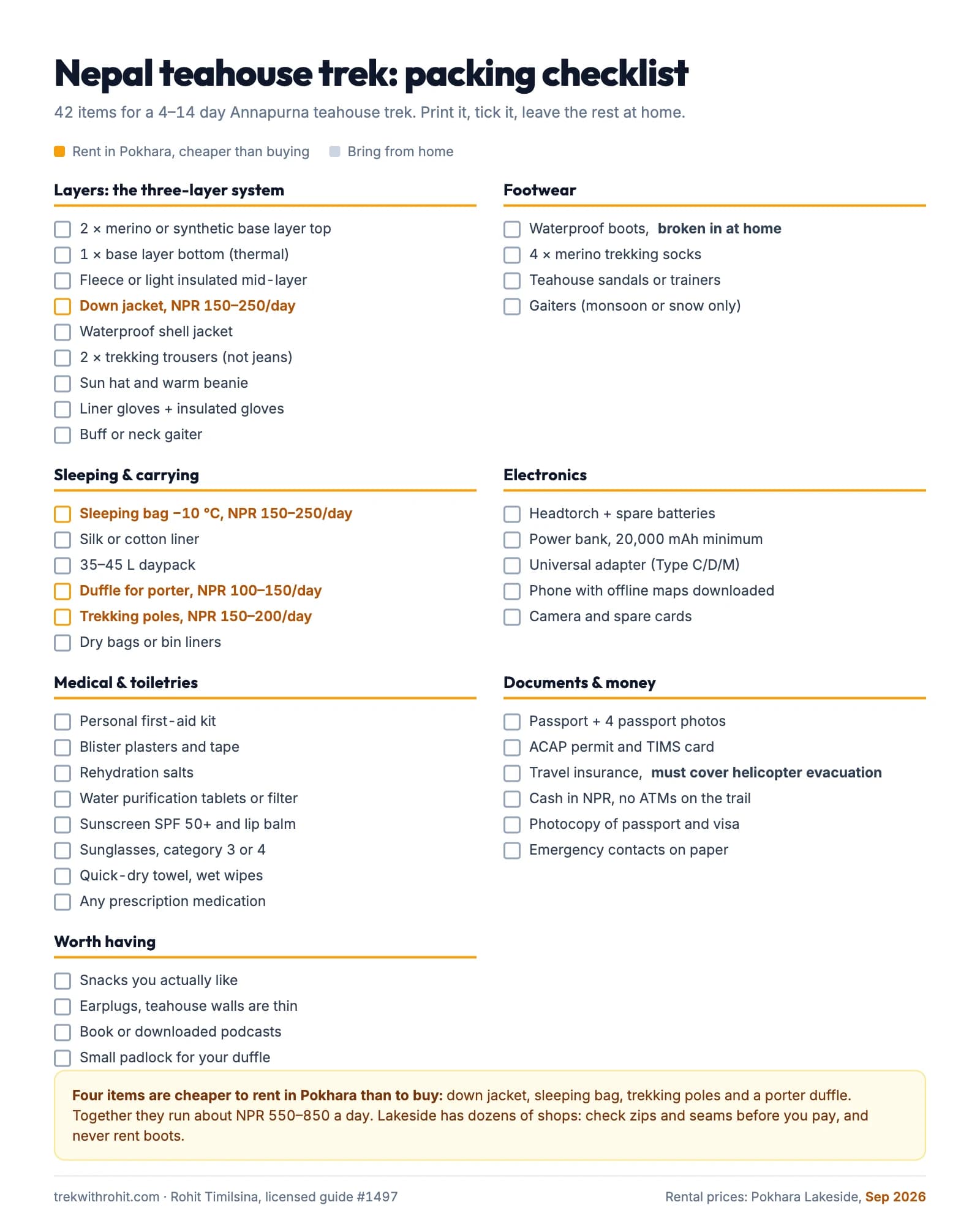
Overpack and your knees suffer. Underpack and you will be cold, unprepared, or buying overpriced gear in Namche Bazaar. This is the practical list I give every trekker before they fly to Kathmandu.
The short version
- 1.42 items covers a 4 to 14 day teahouse trek. Target 8 to 12 kg in the daypack if you are carrying it yourself.
- 2.The three-layer system does the work: wicking base, insulating mid, waterproof shell. Everything else is detail.
- 3.Four items are cheaper to rent in Pokhara than to buy: down jacket, sleeping bag, poles and a porter duffle. Around NPR 550 to 850 a day together.
- 4.Never rent boots. Bring your own, broken in at home. Blisters end more treks than altitude does.
- 5.No jeans and no cotton. Both hold water, take a day to dry and get genuinely dangerous once the temperature drops.
Target daypack weight
8 to 12 kg
Porter carries your duffle (max 15 kg). Daypack is on your back every step.
Bring less than you think you need.
Everything you can rent in Pokhara, rent.
Clothing - The Three-Layer System
Nepal's altitude range means you move from subtropical heat to below-freezing cold within hours. Layers that can be added and removed are essential.
Base Layer
- ✓2–3 moisture-wicking long-sleeve tops (merino wool or synthetic)
- ✓2 pairs trekking trousers (zip-off or quick-dry)
- ✓3–4 pairs merino or synthetic trekking socks
- ✓Thermal underwear for cold nights above 3,500 m
- ✓1 lightweight fleece or midlayer top
Insulating Layer
- ✓Down jacket (600–700 fill; rent in Pokhara for ~NPR 200/day)
- ✓Fleece jacket (for mid-altitude evenings)
- ✓Warm hat / beanie covering ears
- ✓Lightweight gloves + heavier liner gloves for high altitude
- ✓Neck gaiter or buff
Shell / Outer Layer
- ✓Waterproof, breathable rain jacket (Gore-Tex or equivalent)
- ✓Lightweight rain trousers or waterproof overtrousers
- ✓Waterproof backpack cover (most pack companies include one)
Footwear
Your boots are the single most important piece of equipment. Blisters on day 2 of a 14-day trek are not a minor inconvenience - they are a trip-ender. Break boots in for a minimum of 8 full walking days before you land in Nepal.
- ✓Waterproof ankle-support trekking boots - broken in, not brand new
- ✓Lightweight camp sandals or flip-flops for teahouse evenings
- ✓Gaiters (optional but useful in snow on Manaslu, EBC in winter)
- ✓Trekking poles - either bring or rent in Pokhara (NPR 150–200/day)
Sleeping Gear
Teahouses provide blankets, but blanket hygiene varies and they are never warm enough above 4,000 m. Your own sleeping bag is non-negotiable on Manaslu, EBC, and Annapurna Base Camp.
- ✓Sleeping bag rated to −10 °C comfort (−15 °C for Manaslu above 4,000 m)
- ✓Sleeping bag liner (adds 3–5 °C warmth, packs tiny - worth carrying)
- ✓Inflatable or foam sleeping pad (not usually needed - teahouses provide mattresses)
Sleeping bags rated to −10 °C can be rented in Pokhara Lakeside for approximately NPR 150–250/day. Bring your own liner regardless - liners are personal and cheap.
Electronics
- ✓Headlamp with spare batteries - power cuts are common in teahouses
- ✓Power bank (20,000+ mAh) - charging in teahouses costs NPR 200–400 per device
- ✓Universal travel adapter (Nepal uses Type C, D, and M sockets)
- ✓Camera / phone - lens cloths essential in dust and rain
- ✓Offline maps downloaded before departure (Maps.me or Gaia GPS)
- ✓Satellite communicator (optional but recommended for Manaslu and restricted areas)
Toiletries & Medical Kit
High altitude UV, dry air, and trail dust create specific needs. The medical kit below covers the most common issues on Nepal treks. Consult your doctor before taking Diamox - it is a prescription medication in most countries.
Toiletries
- ✓SPF 50+ sunscreen (high-altitude UV is severe)
- ✓Lip balm with SPF
- ✓Biodegradable soap and shampoo
- ✓Quick-dry travel towel
- ✓Hand sanitiser
- ✓Wet wipes (teahouses above 4,000 m have no showers)
- ✓Toilet paper + small trowel (some remote sections lack facilities)
Medical Kit
- ✓Diamox (acetazolamide), only if your doctor prescribes it for AMS prevention
- ✓Ibuprofen / paracetamol for headaches and pain
- ✓Oral rehydration salts
- ✓Blister treatment kit (moleskin, gel pads)
- ✓Loperamide (anti-diarrhoeal) and antacids
- ✓Antiseptic wipes and small wound dressings
- ✓Elastic bandage for ankle support
- ✓Water purification tablets or SteriPen
For a full AMS and altitude sickness guide, see: Altitude Sickness on Nepal Treks - Prevention & Treatment.
Documents to Carry
- ✓Original passport (needed at every permit checkpoint)
- ✓Nepal visa (on-arrival stamp or e-Visa printout)
- ✓Trekking permits - TIMS, ACAP, national park entry
- ✓Travel insurance policy documents with emergency number (must cover helicopter evacuation above 4,000 m)
- ✓4–6 passport photos (for permits and any last-minute requirements)
- ✓Emergency contact card in English and Nepali (Rohit provides this to his trekkers)
- ✓Photocopies of all documents stored separately from originals
What to wear at each altitude band
The same three layers cover the whole trek. What changes is how many of them are on at once, and when. These are the combinations I actually see working on the Annapurna trails, in the trekking seasons.
| Altitude | Walking | Teahouse, evening |
|---|---|---|
| Below 2,000 m | Base layer only, sun hat | Base layer, light fleece |
| 2,000 to 3,000 m | Base layer, shell if windy | Fleece, sometimes down |
| 3,000 to 4,000 m | Base plus fleece, shell on ridges | Down jacket on as soon as you stop |
| Above 4,000 m | All three layers, gloves, buff | Down jacket and hat indoors |
The mistake I see most: people walk in the down jacket and arrive soaked in sweat, then freeze the moment they stop. Walk cold, layer up the second you sit down.
Rent in Pokhara vs Bring from Home
Pokhara Lakeside has dozens of trekking gear shops where you can rent or buy quality gear. Renting makes sense for bulky, trip-specific items you will not use again. Buying in Pokhara is fine for lower-cost consumables - though verify quality carefully before heading to altitude.
| Item | Recommendation | Approx. Pokhara Cost |
|---|---|---|
| Down jacket | Rent in Pokhara | NPR 150–250/day |
| Sleeping bag (−10 °C) | Rent in Pokhara | NPR 150–250/day |
| Trekking poles | Rent in Pokhara | NPR 150–200/day |
| Duffle bag (for porter) | Rent in Pokhara | NPR 100–150/day |
| Waterproof trekking boots | Bring from home (broken in) | Buy: NPR 2,000–8,000 |
| Trekking socks | Bring from home (merino) | Buy: NPR 400–1,200/pair |
| Headlamp | Bring from home | Buy: NPR 500–2,000 |
| Power bank | Bring from home | Buy: NPR 2,000+ |
| Rain jacket | Bring from home | Buy: NPR 3,000–15,000 |
| Sunscreen SPF 50+ | Bring from home or buy Kathmandu | Buy: NPR 800–2,000 |
Related Planning Guides
Ready to go?
Not sure what you actually need?
Tell me your trek and dates. I will send a personalised packing list based on the specific route, altitude, and season - and arrange gear rental in Pokhara before you arrive.
Get My Personalised Packing List