Quick facts
A quiet loop through Gurung heartland northeast of Pokhara — Sikles village, rhododendron ridges, and the cold turquoise waters of Kapuche Glacier Lake at 3,600m.
Overview
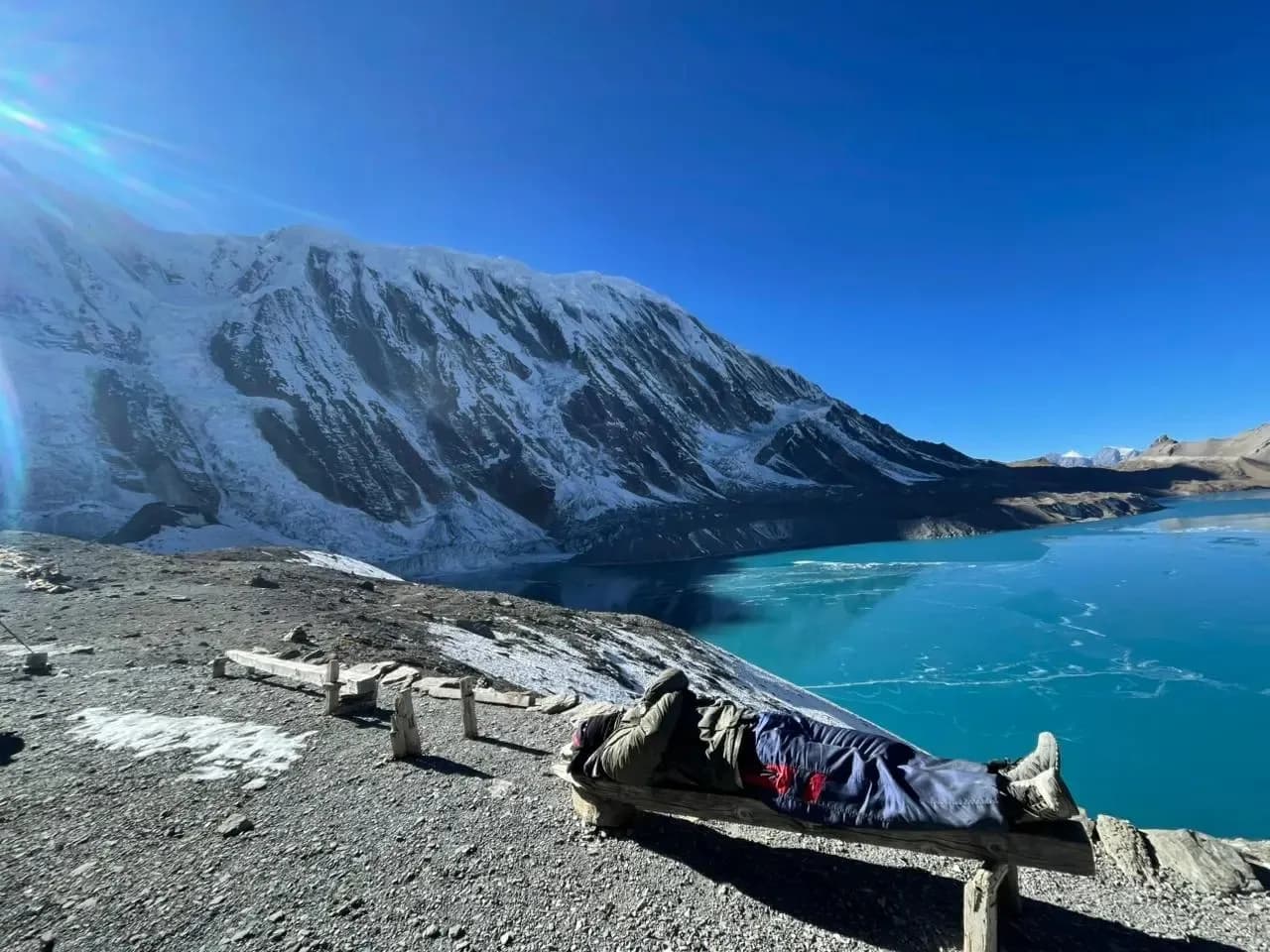
The Kori Trek sits in a corner of the Annapurna Conservation Area that most trekkers drive past on the way somewhere else. It begins in Sikles, one of the oldest and largest Gurung villages in the region, and climbs northeast through pine and rhododendron forest toward the highland called Kori Danda and the striking Kapuche Glacier Lake. Kapuche is one of the lowest-altitude glacier lakes in Nepal — the water stays ice-cold year-round and the surrounding ridgeline gives an unobstructed view of Annapurna II and Lamjung Himal.
I started guiding this route a few years ago, partly because I was getting tired of seeing the same faces on the Ghorepani trail and wanted something quieter for clients who had done the classics. The trail rarely appears in agency brochures, which means you will likely have the teahouses and campsites to yourself — a genuine rarity in the Annapurna region these days. The Gurung households in Sikles and the small settlements along the way are welcoming, and if you go in spring the rhododendron bloom between 2,000m and 3,000m is as good as anywhere in Nepal.
This is a community-managed trail that does not appear in most printed guidebooks. The exact itinerary flexes depending on your group's pace and homestay availability at the upper settlements. I treat it as a four-day minimum; five or six days lets you move at a comfortable pace and spend a proper morning at Kapuche Lake before the clouds come in.
Who this trek is for
Trekkers who have done the Ghorepani or Poon Hill circuit and want something quieter in the same region. Also good for anyone wanting a genuine Gurung cultural experience without heavy tourist infrastructure. Moderate fitness needed for the day up to Kapuche. Note: this is a community-managed trail with limited documentation; itinerary may flex depending on homestay availability at the upper camps.
Best views & moments
- Kapuche Glacier Lake (3,600m) — one of the lowest glacier lakes in Nepal, vivid turquoise, rarely crowded
- Sikles village — one of the largest traditional Gurung settlements in the Annapurna foothills
- Unobstructed ridge views of Annapurna II, Lamjung Himal, and Machhapuchhre
- Rhododendron forest in full bloom between 2,000m and 3,000m (March-April)
- Quiet trails — virtually no commercial trekking traffic compared to Ghorepani or Mardi Himal routes
- Authentic homestay nights in Gurung households along the upper ridge
Day-by-day itinerary
Route & terrain
The route begins at Sikles, one of the largest Gurung villages in Kaski District, accessible by road from Pokhara in roughly two hours. From Sikles the trail climbs northeast along the main ridge, passing through rhododendron and pine forest to the highland settlement of Hugu Goth. From there a further climb leads to the Kapuche Glacier Lake at 3,600m, set in a high bowl below a small glacier fed by snowfields off Annapurna II and Lamjung Himal. The return follows the same ridge back to Sikles. An alternative variation extends to Kori Danda for an additional viewpoint before returning, adding roughly half a day. The trail is not waymarked for independent trekkers; a local guide is essential.
General info
Difficulty & preparation
Rated Moderate. The main challenge is the sustained climb from Hugu Goth to Kapuche Lake at 3,600m, which gains roughly 1,000m over a few hours on an uneven trail. The rest of the route — below 2,600m — is straightforward forest walking on good paths. There are no exposed sections or technical ground. The altitude is well below AMS concern thresholds for most trekkers. Good fitness and sturdy footwear matter more than any prior trekking experience. The descent from Kapuche is steep in places and can be slippery in wet weather.
How to prepare
No acclimatisation days are needed at this altitude. Basic cardiovascular fitness — able to walk five to seven hours with some load — is sufficient. Train with uphill walking if you can. The trail above Hugu Goth is not well maintained compared to commercial routes, so ankle stability is worth considering. Bring layers for the Kapuche Lake area even in autumn; the bowl traps cold air. I carry a first aid kit and an emergency shelter on this route as teahouse support above Sikles is limited.
Permits you'll need
Annapurna Conservation Area Permit (ACAP)
NPR 3,000 (foreigners) / NPR 1,000 (SAARC nationals)
Issued in Pokhara (NTNC Damside office) or Kathmandu. Mandatory before entering the conservation area from Sikles.
TIMS Card
NPR 1,000 (with registered guide/agency) / NPR 2,000 (individual)
Trekkers' Information Management System card. Issued at Nepal Tourism Board office in Pokhara or Kathmandu.
I handle all permit paperwork as your licensed guide.
Altitude & acclimatisation
Maximum altitude is 3,600m at Kapuche Lake, well below the threshold where acute mountain sickness becomes a significant concern (typically above 3,500m for rapid ascents, but this route approaches the lake gradually over two days). Mild symptoms — slight headache, reduced appetite — are possible for some people at the lake. Descend if symptoms persist. No acclimatisation rest days are built into the standard itinerary. Drink plenty of water, avoid alcohol, and don't rush the ascent on day three.
Food & accommodation
Accommodation in Sikles is in Gurung family homestays — simple but clean rooms, shared facilities, home-cooked meals. Above Sikles the options thin out significantly; at Hugu Goth there may be one or two basic lodges or a homestay depending on the season, but this is not guaranteed. I recommend treating the upper section as a camping or packed-lunch arrangement if availability is uncertain. At Kapuche Lake there is no fixed accommodation — day-use only on most itineraries. Meals are dal bhat, noodles, and simple Nepali home food throughout.
What to pack
Layers are essential above 3,000m even in October and November — temperatures at the lake area can drop sharply overnight. Waterproof outer layer, insulating mid-layer, warm gloves, and a buff cover the range of conditions. Trekking poles help on the steep descent from Kapuche. Bring a reusable water bottle and purification tablets — clean water is available at homestays but not always along the upper trail. A headtorch with spare batteries is useful if the homestay has no grid power.