Quick facts
An off-the-beaten-track ridgeline hike north of Pokhara through Gurung villages and rhododendron forest to a sweeping panoramic viewpoint, with very few other trekkers on the trail.
Overview
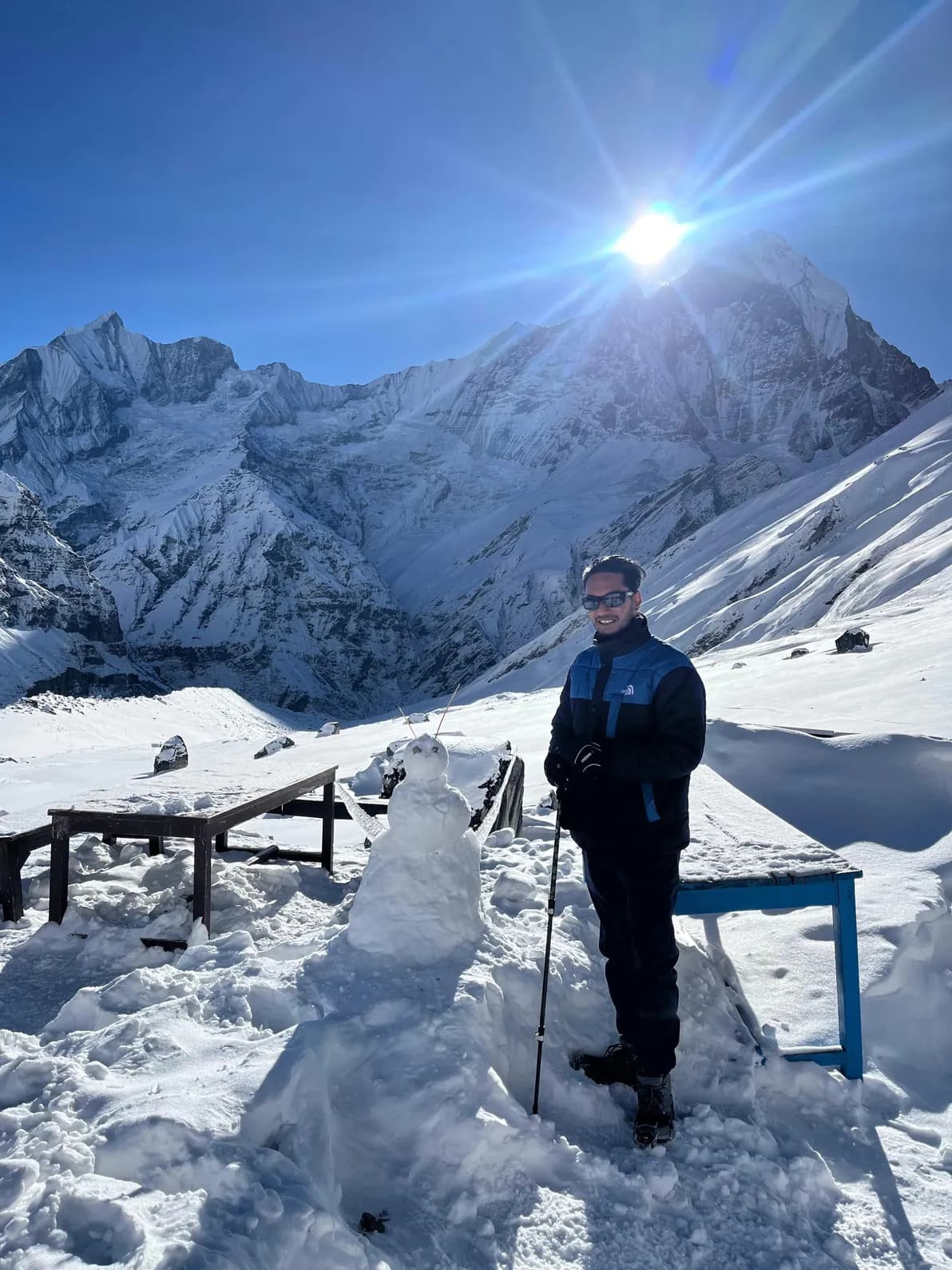
Khumai Danda sits on a ridge above Ghachowk village, roughly 20 kilometres from Pokhara, and offers something that is increasingly rare in the Annapurna region: genuine solitude. The trail climbs through mixed forest — pine, oak, rhododendron — passing small Gurung settlements and farmland before arriving at Khumai Danda's open ridgeline at around 3,245m. From there, an optional further push to Korchan Danda (3,682m) gives a 360-degree view of Machhapuchhre, Annapurna South, Annapurna I, Dhaulagiri, Lamjung Himal, and Hiunchuli.
What makes this trek distinctive is the quality of the wildlife and forest on the approach. The rhododendron forest between Ghachowk and Hile Kharka is excellent birdwatching terrain — Himalayan Monal (Nepal's national bird) is regularly seen in spring, and Langur monkeys are common at the forest margins. In spring the hillsides above Ghachowk are covered in pink and red rhododendron blooms, which put the ridge walk in a different category entirely.
Accommodation on this route is in local teahouses and Gurung family homestays. The infrastructure is more basic than on the main Annapurna trails — this is not a route with menu-heavy teahouses and hot showers at every stop. What you get instead is a genuine connection with the landscape and the farming communities that live in it. The trail is suitable for competent day-hikers with good fitness who want a short but rewarding mountain experience.
Who this trek is for
Trekkers who want a short, quiet ridge experience without the crowds of Poon Hill or Australian Camp. Good for fit beginners who want a taste of genuine mountain territory, birdwatchers (Himalayan Monal is reliably seen in spring), photographers working in the golden hours, and anyone based in Pokhara who has already done the standard day hikes and wants something less travelled. Families with older children who are comfortable with 5-6 hour walking days will enjoy this.
Best views & moments
- Panoramic sunrise from Khumai Danda ridge — Machhapuchhre, Annapurna I, South, Dhaulagiri, and Lamjung Himal in one sweep
- Optional climb to Korchan Danda (3,682m) for an even wider 360-degree Himalayan panorama
- Dense rhododendron forest in bloom between Ghachowk and Hile Kharka in spring
- Himalayan Monal — Nepal's national bird — regularly spotted along the forest trail
- Genuine Gurung village experience in Ghachowk and at homestays along the route
- Almost no other trekkers — trail solitude that is hard to find on main Annapurna routes
- Grazing yak and mountain goats on the upper ridges near Korchan Danda
Day-by-day itinerary
Route & terrain
The trek starts at Ghachowk, a village accessible by a 1.5-hour drive on a partially paved road from Pokhara. The trail from Ghachowk begins in farmland and quickly enters mixed forest that becomes increasingly dense as altitude rises. The forest is well-watered and supports exceptional biodiversity — this is one of the better birdwatching trails in the Pokhara region.
Hile Kharka at 2,100m is the first overnight stop, situated in a clearing that gives good views north toward the Annapurna range. The second day climbs through thicker rhododendron forest before breaking above the tree line onto the open Khumai Danda ridge. The ridge itself runs roughly north-south and provides views in all directions — the Annapurna massif to the north-east, Dhaulagiri to the north-west, and the Pokhara valley below to the south.
The descent follows a different line, dropping through forest and terraced agricultural land to Ghalel village, where road access is available. Total trekking distance over 2-3 days is approximately 25-30 km.
General info
Difficulty & preparation
Khumai Danda is rated Easy-Moderate. Daily walking times are 5-6 hours with moderate gradient — the climb from Hile Kharka to the ridge involves sustained uphill walking through forest and requires reasonable fitness. The maximum altitude at Khumai Danda (3,245m) or Korchan Danda (3,682m) is not high enough to cause altitude sickness in most trekkers arriving from Pokhara, though mild headache is possible at the higher viewpoint. The trail is less maintained than the main Annapurna routes and is not always clearly marked — a local guide is strongly advised.
How to prepare
Prepare with regular walking or hiking in the 4-6 weeks before the trek. The trail involves sustained climbs on forest paths that can be slippery after rain. Break in your hiking footwear before you arrive. Bring basic first aid supplies and any personal medication. The trail has limited resupply points, so carry enough water and snacks for full trekking days.
Permits you'll need
Annapurna Conservation Area Permit (ACAP)
NPR 3,000 (foreigners) / NPR 100 (SAARC) per person
Required. Buy in Pokhara before departure.
TIMS Card (Trekkers' Information Management System)
NPR 2,000 (independent) / NPR 1,000 (group) per person
Available in Pokhara at the Nepal Tourism Board office.
I handle all permit paperwork as your licensed guide.
Altitude & acclimatisation
The maximum altitude at Khumai Danda (3,245m) is low enough that altitude sickness is unlikely for trekkers who have had even a day to acclimatise in Pokhara. Korchan Danda at 3,682m is the upper limit of this route — at this elevation some trekkers experience mild headache, particularly if they ascend quickly from Hile Kharka. Walk slowly, drink water, and rest if you feel symptoms. Descent of even a few hundred metres will resolve any discomfort at this altitude.
Food & accommodation
Accommodation is in simple local teahouses and Gurung family homestays. Facilities are basic — shared bathrooms, wooden beds, blankets. Electricity is available at most stops but charging may require a small fee. Hot showers are not reliably available. Food is Nepali home cooking: dal bhat, noodle soups, omelets, and tea. Do not expect the diverse menus of the main Annapurna circuit teahouses. The simplicity of the food and accommodation is part of what makes this route feel authentic rather than packaged.
What to pack
Pack light for this short trek. A 25-30 litre daypack works well. Essential items: hiking boots with ankle support, waterproof jacket, warm fleece or down layer for evenings and early starts on the ridge, sunscreen and hat, water (2 litres minimum), trail snacks, headlamp, trekking poles. Binoculars are well worth bringing in spring for birdwatching on the forest trail. Teahouses on this route provide basic bedding — a sleeping bag liner adds comfort.