Planning Guide
12-Week Fitness Plan for a Nepal Trek
Poon Hill and Mardi Himal need the first eight weeks of this plan. Annapurna Base Camp, Manaslu and Everest Base Camp need all twelve. Here is the whole thing week by week, with the two tests I use to work out where a trekker actually is before they book anything.
The short version
- 1.Twelve weeks, three phases: base (weeks 1–4), build (5–8), peak (9–12). Each phase ends in a test you either pass or repeat, not a feeling.
- 2.Two tests tell you where to start: 15 km with an 8 kg pack in under 4 hours, and 1,000 stairs without stopping. Pass both and you start at week 5 instead of week 1.
- 3.Weeks 1–8 are enough for Poon Hill and Mardi Himal. Annapurna Base Camp, Manaslu Circuit and Everest Base Camp need all 12 weeks.
- 4.The peak phase is back-to-back days: 15 km on Saturday, 12 km on Sunday with a full pack. A Nepal trek is 5 to 14 of those in a row, so one big Sunday walk a week does not prepare you for it.
- 5.Fitness does not prevent altitude sickness. They are separate problems. I have watched very fit people struggle above 4,000 m while nervous, ordinary walkers finished strong.
How fit do you need to be before you start training?
Two tests, and you need to pass both: 15 km with an 8 kg pack in under 4 hours, and 1,000 stairs without stopping. Pass both and you can start this plan at week 5. Fail either one and you start at week 1. No gym equipment needed for either, just honesty with yourself.
Walk 15 km with an 8 kg pack
Can you complete this in under 4 hours without stopping from exhaustion? If not, you're in the base-building phase. If yes, you're ready to start week 5 directly.
Climb 1,000 stairs without stopping
Stair climbing mimics ascent grade better than any gym machine. If you need multiple breaks in the first 500 stairs, start from week 1. Nepal trails average 400m+ of climb per day.
What does a 12-week trek training plan look like?
Twelve weeks in three four-week phases: base, build and peak. Each phase has one goal and one readiness test, and you do not move up a phase until you have passed the test for the one you are in. The load climbs from comfortable daily walks to back-to-back loaded days that feel like the middle of a real trek.
| Phase | Weeks | What you do each week | Target |
|---|---|---|---|
| BaseWalk 10 km comfortably, climb 30 floors | 1–4 |
| Walk 10 km with a light daypack without fatigue |
| Build15 km with a 5–8 kg pack, 30+ floors without stopping | 5–8 |
| 15 km hike with an 8 kg pack, 30 consecutive floors |
| PeakBack-to-back long days, simulate altitude fatigue | 9–12 |
| Back-to-back 15 km days with a 10 kg pack, minimal soreness |
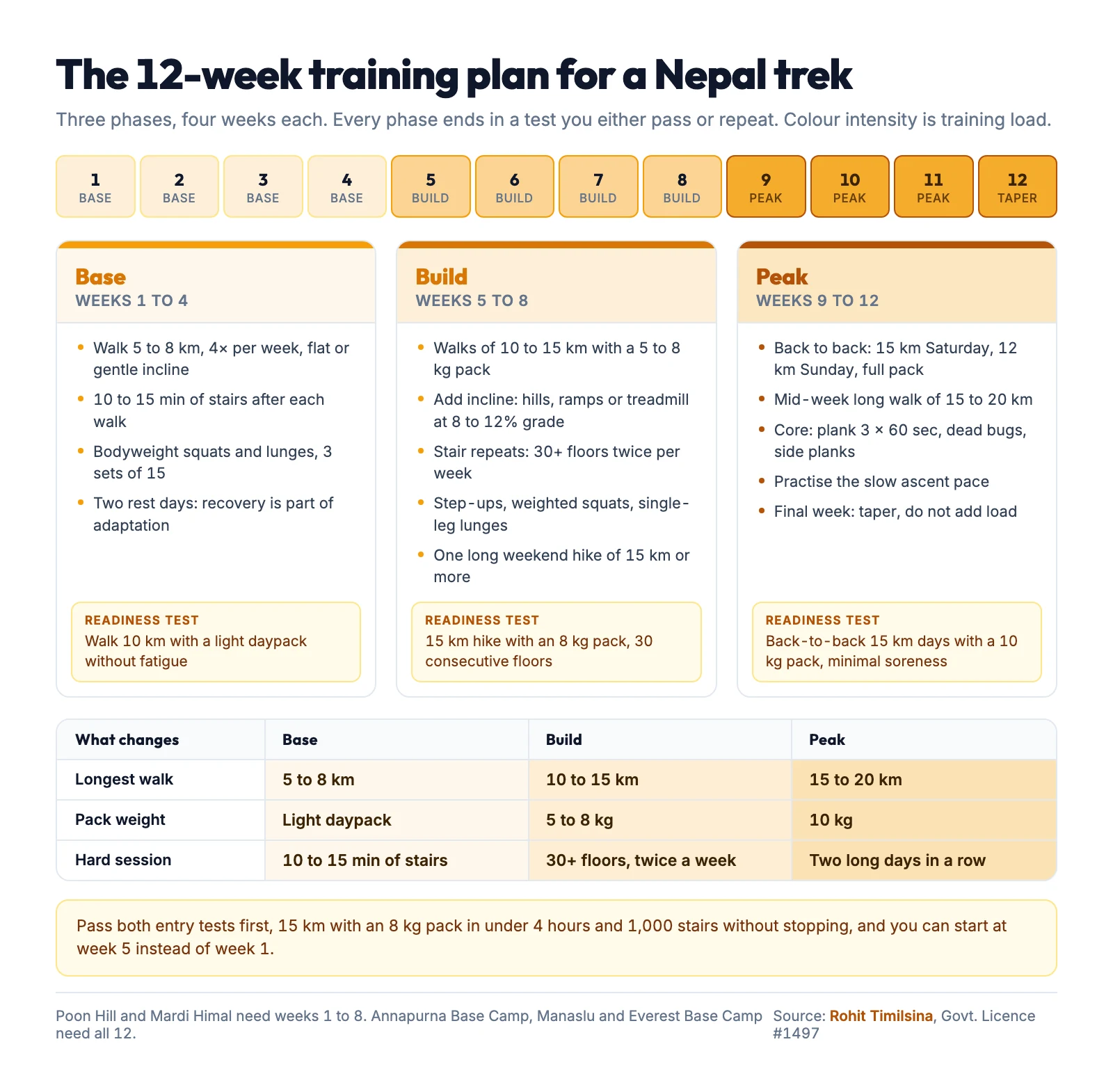
If you fail a phase test, repeat that phase rather than moving on. Twelve weeks is the plan for someone starting from a normal, non-athletic base. Nobody I guide has ever regretted arriving over-prepared.
How to train for trekking in Nepal
Train for 5 to 14 consecutive days, not for one good day. That is the gap between generic hill fitness and Nepal fitness, and it is where most of the trekkers I take out get caught. Three things are specific to here.
1. Consecutive days, not one long day
A Poon Hill trek is 5 days. Everest Base Camp and the Manaslu Circuit are 14. You walk, sleep badly at altitude, eat dal bhat, and do it again. Someone who trains one long Sunday walk arrives able to do day one brilliantly and day four badly, which is exactly when the trail gets serious. That is the whole point of the back-to-back weekends in weeks 9 to 12: the second day is the training, the first day is just the warm-up.
2. Descent is the part that actually hurts
Almost every sore knee, wrecked quad and blackened toenail I deal with happens on the way down. The Annapurna trails are stone staircases, thousands of steps at a time, and coming down them your legs are absorbing load rather than producing it. Untrained calves are destroyed by that in a day. Train the descent as deliberately as the climb: walk down hills slowly under a loaded pack, and do the calf raises (3 × 25) in the strength list below from week 1 rather than adding them at the end.
3. Altitude is a separate problem from fitness
No amount of training protects you from altitude sickness. Acute mountain sickness is not correlated with fitness: it is governed by how fast you gain sleeping altitude, which is a decision about the itinerary, not about your legs. Training buys you something different but real, which is spare capacity, so that a hard day does not leave you too exhausted to notice a headache getting worse. Read the altitude sickness guide before you fix your itinerary, because the ascent rate matters more than any of this.
What strength exercises matter most for trekking?
Six movements cover it: squats, reverse lunges, weighted step-ups, calf raises, plank and dead bug. Legs and core are what carry you to 5,364 m and back down again. Knee stability and lower-back endurance decide whether you finish strong or limp into camp.
Squats
3 × 15–20Quad and glute strength for sustained climbing
Reverse lunges
3 × 12 each legKnee stability and single-leg balance on uneven terrain
Step-ups (weighted)
3 × 10 each legDirectly mimics trail ascent. Use a box or bench at 40–50 cm
Calf raises
3 × 25Steep descents destroy untrained calves. Build this early
Plank
3 × 45–90 secondsCore stabilizes your pack load and protects lower back
Dead bug
3 × 10 each sideAnti-rotation core strength for carrying a loaded pack all day
What fitness level does each Nepal trek require?
Weeks 1 to 8 are enough for the two 5-day routes, Poon Hill and Mardi Himal. The 10 and 14-day routes, Annapurna Base Camp, Manaslu Circuit and Everest Base Camp, need the full 12 weeks. Manaslu also wants prior altitude experience, and for Everest I want to see the back-to-back test passed before we set the itinerary.
| Trek | Days | Max altitude | Training needed | Fitness level |
|---|---|---|---|---|
| Poon Hill Trek | 5 days | 3,210 m | Weeks 1–8 sufficient | Moderate |
| Mardi Himal Trek | 5 days | 4,500 m | Weeks 1–8 plus acclimatization days | Moderate |
| Annapurna Base Camp | 10 days | 4,130 m | All 12 weeks | Good |
| Manaslu Circuit | 14 days | 5,160 m pass | All 12 weeks, prior altitude experience ideal | Strong |
| Everest Base Camp | 14 days | 5,364 m | All 12 weeks, must pass the back-to-back test | Strong |
Mardi Himal is the one people underestimate. It is only 5 days, but it tops out higher than Annapurna Base Camp, so the fitness is moderate while the acclimatization is not. Prepare your body for EBC by completing the full peak phase. Manaslu demands the same.
From the trail
“You don't need to be an athlete. But the fitter you are, the more you'll enjoy it instead of just surviving it. I've guided people who were nervous about their fitness and finished strong, because they prepared. And I've seen very fit people struggle because they underestimated altitude.”
Rohit, Pokhara guide, Govt. Licence #1497
Related planning guides
Ready to go?
Not sure if you're fit enough for your chosen trek?
Tell me your current weekly walking distance and I will tell you honestly which of these five routes fits, and adjust the daily distances to your pace once you are on trail.
Ask Rohit About Your Fitness Level